Introduction
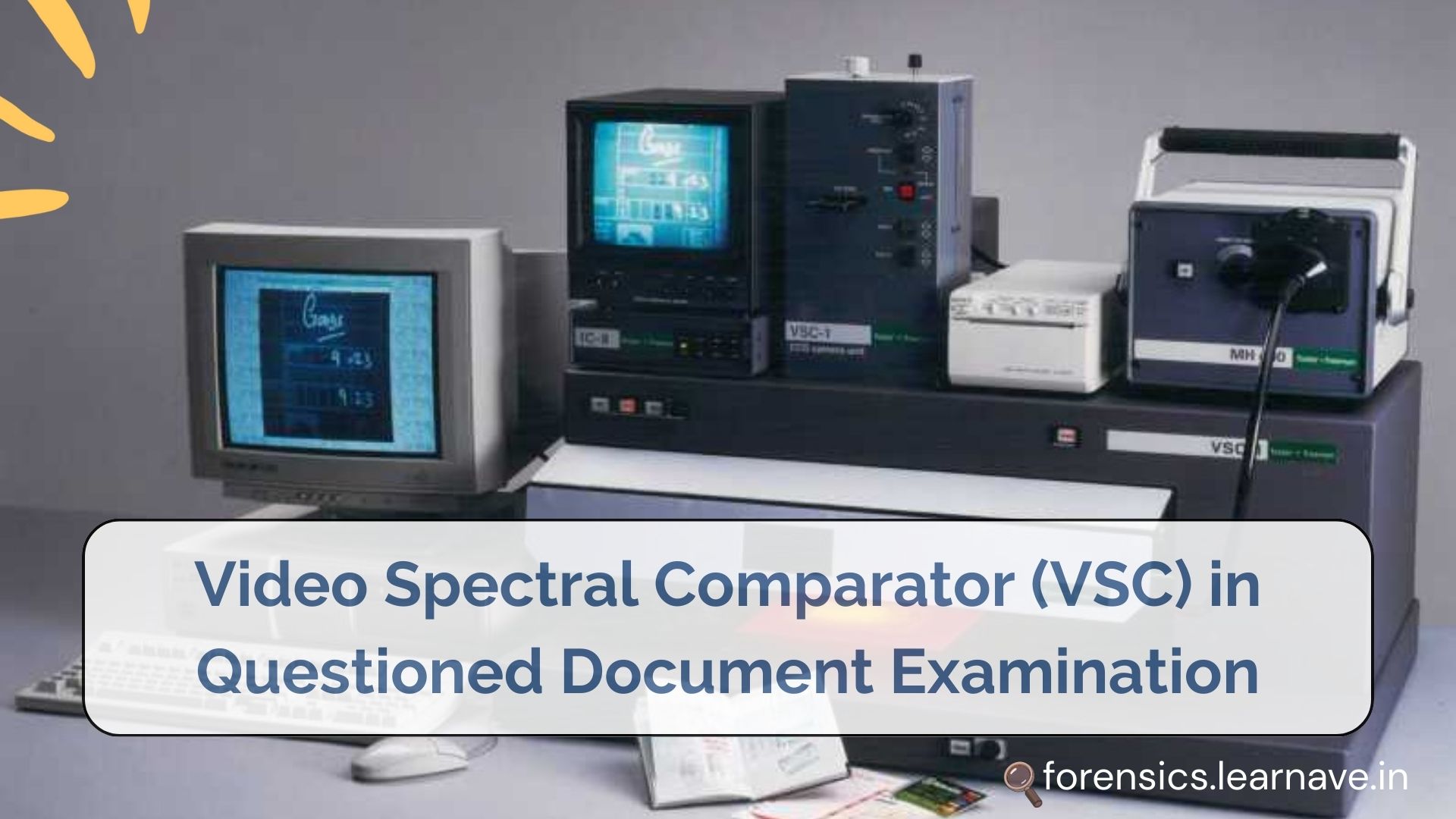
Video Spectral Comparator (VSC) is an integrated composite system comprising of cameras, various light sources which includes IR, Laser, UV etc. and filters which assist in comparison of questioned documents.
It is also defined as comprehensive digital imaging system combining high resolution optics and multi-spectral illumination with a powerful software package that includes tools for image enhancement and decoding digitally encrypted data. Access to optional reference databases enables comparisons with authentic security documents.
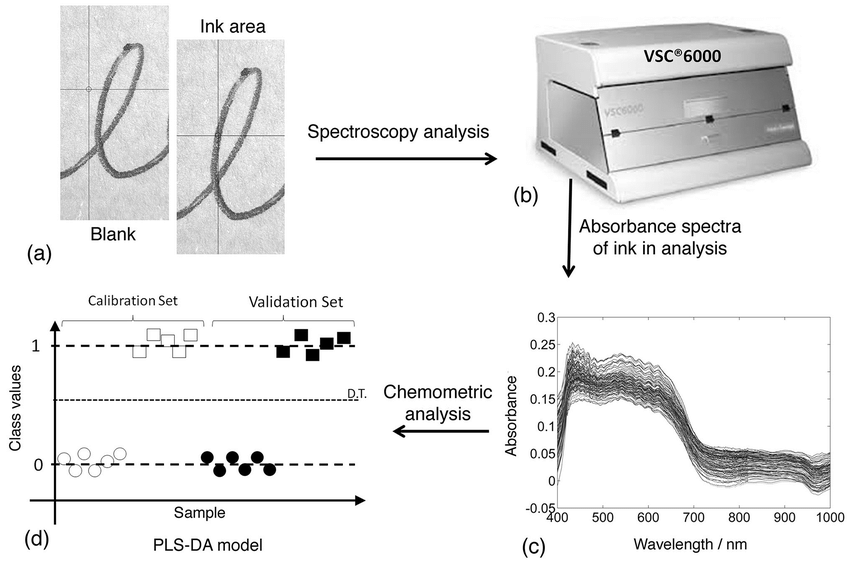
VSC6000 is the new version of VSC which is available for use for the forensic and general purposes.
Principle of Video Spectral Comparator (VSC)
- It works on the basic principle of light.
- Light is a form of electromagnetic radiation and consists of different wavelengths.
- When light directed towards an object any of the one of five things usually occurs depending on the emitted wavelengths and the composition of the object –
- Reflection: object appears white or lighter.
- Absorption: All or most of the light can be absorbed by the object. object appears black & darker.
- Reflection & Absorption: Reduces colours in the visible portion of the spectrum.
- Transmission
- Luminescence: It strikes the object, be absorbed and then reemitted at a longer wavelength.
Important Notes on Light and VSC
- Visible range in the electromagnetic spectrum to humans 400nm – 700nm
- Infrared (IR) and Ultraviolet (UV) radiations are not visible to humans.
- The object that absorbed light in the visible spectrum and appeared black can now transmit radiant energy in the IR spectrum.
- VSC is a non-destructive technique.
Construction of Video Spectral Comparator
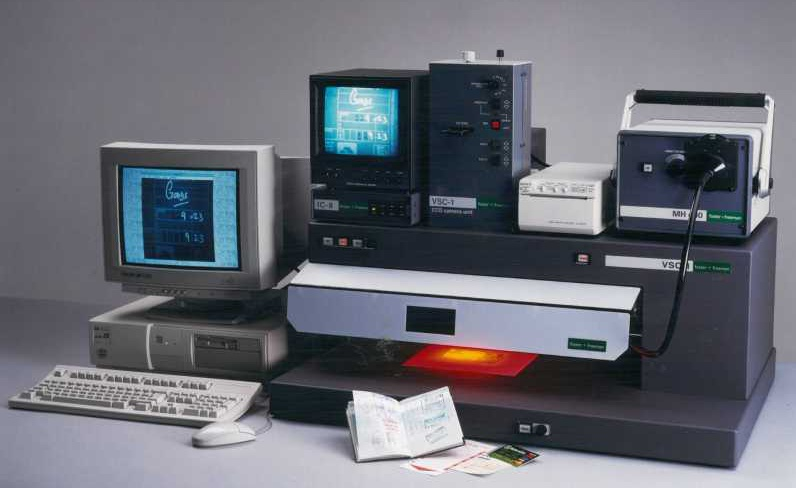
- The VSC consists of a main unit and a PC system.
- The main unit is a square box with 3 flaps.
- The main unit has a high resolution CCD firewire colour camera with sensitivity from 365nm – 1100nm to , different light sources (incandescent filament lamps, LED, vapour discharge tube, flash
- tube etc), optical filters as well as a translight panel.
- The panel is situated in the centre of the document platen.
- Underneath the panel are light sources which can illuminate the document from below.
- The document platen in itself 650nm × 175nm while the translight panel is 235nm × 175nm.
- In the VSC there is also a high resolution grating spectrometer. It can analyze light from a small region in the document.
- As part of the VSC machinery is a 30” screen and a PC system which is Windows based.
Light Sources Used in Video Spectral Comparator
Illumination & Spectral Analysis
| Wavelength (nm) | Illumination Mode | Technical Usage & Application |
|---|---|---|
| 400 – 700 Visible |
Coaxial Lighting | Shown perpendicularly on the document to reveal retro-reflective features; vital for preventing forgeries. |
| LED Lamps | used with coaxial lighting and diffracted lighting. | |
| Diffracted Lighting | illuminates the document from different directions, and is usually used to see Optically Variable Devices (OVD). | |
| 365 UV-A | Transmitted UV | Vapour discharge tubes illuminate the document from above to excite specific security inks. |
| 312 UV-B | UV Lighting | |
| 254 UV-C | UV Lighting | |
| 850 – 1100 IR | Anti-Stokes Flash | Narrow-band illumination used to excite specialized anti-Stokes fluorescence. |
| 400 – 1000 Visible + IR |
Flood Lighting | Broadband illumination for general spectral inspection. |
| Transmitted Lighting | Utilizes UV light at 365nm to penetrate document substrates. | |
| Side Lighting | High-intensity illumination using a single lamp positioned directly above the platen for relief analysis. | |
| Incandescent Filament | Versatile source supporting flood, transmitted, spot, and side lighting modes. |
Applications of Video Spectral Comparator in Forensic Science
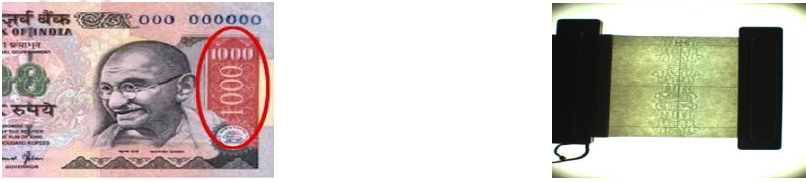
- Objects such as currency, stamps, legal documents, artwork, and identification cards, etc. can be examined.
- Used to observe security feature of bank notes like ink, images, paper gradient and security thread.
- To examine suspected fake cheques, fake certificates, notarized documents, license agreements, degree certificates, birth certificates, etc.
- To examine passport and visa documents at airports.
- Examination of documents under high magnification can quickly reveal evidence of tampering.
- Reveal Latent Images and Watermark.
- Anti Strokes Illuminator.
- Examining UV activated security features.
Features of Video Spectral Comparator (VSC)
Hi-Fi Imaging Technology
An optical system that minimizes spatial distortions and chromatic aberration throughout the entire magnification range offering excellent image quality.
Full Range Light Source System
Includes incident and transmitted ultraviolet to infrared plus high intensity illumination for the examination of Infrared Florescence of inks.
Graphical User Interface (GUI)
Innate, on screen control system allows the operator to navigate the system more easily. Magnification, light sources, filters, image analysis and image processing functions are selected from simple on screen icons using mouse.
Multiple Laser Imaging (MLI)
MLI and changeable Laser Images can be viewed using the VSC’s side lights. Alternatively the VSC range of hologram imaging LED’s can be used giving great flexibility.
Intelligent Software System
VSC ensures compatible combination of illumination and imaging filter automatically.
Optically Variable Ink (OVI) Imaging
An optical viewer that create images of OVI print from two angles incident at 45º, simultaneously.
Document Image Comparison Tools
Includes split screen, overlay and alternate strobe.
Micro-Spectrometer Feature
A high resolution real time grating spectrometer, provides absorption, reflectance, transmittance and fluorescence spectra.
Image Integration Feature
A variation in the IR fluorescence emitted by two inks provides a valuable means of detecting a fraudulent alteration to the document.
Hyper Spectral Imaging Technology
Non-invasive, non-destructive method to enhance the spectral differences of inks, toners and pigments. Be used for the detection of forgery, alterations and page substitution of questioned documents as well as for the analysis of paintings and artwork.
ICAO Data Reader in VSC
The OCR allows operations to check data in the machine readable zone of passports and ID cards.
Image Measurement Tools
A software module that enables examiner to make a variety of measurement including distances, angles, areas, circle radii and shape perimeters. A simple calibration procedure also enables absolute values to be computed.
Birefringent Security Feature Examination
A circular polarizer will image security features printed with chiral birefringent pigment which appears to contrast against the background under the polarizer.
Additional Features of Video Spectral Comparator
- Areas of Interest Processing
- Bar code Reader Deciphers
- Color measurement
- Image enhancement
- Invisible information decoders
- Image processing and enhancement
- Programmed examinations
- Latent Images
- High Resolution Imaging System
Conclusion:
The Video Spectral Comparator is an essential non-destructive forensic tool that enables detailed analysis of questioned documents using advanced optical, spectral, and digital imaging techniques. Its applications range from crime investigation to border security and document authentication.
REFERENCES:
- Osborn, A.S. (1929). Questioned Documents, 2nd ed. Albany, New York: Boyd Printing Company. Reprinted, Chicago: Nelson-Hall Co.
- Harrison, W.R. (1958). Suspect Documents: Their Scientific Examination. New York: Praeger.
- Conway, J.V.P. (1959). Evidential Documents. Illinois: Charles C Thomas.
- Hilton, O. (1982). Scientific Examination of Questioned Documents. New York: Elsevier Science Publishing Co.
- Huber R.A. & Headrick A.M. (1999). Handwriting Identification: Facts and Fundamentals. Boca Raton: CRC Press.
- Ellen, D. (2005). Scientific Examination of Documents: Methods and Techniques, Third Edition. Boca Raton: CRC Press.
- Morris, R. (2000). Forensic Handwriting Identification: Fundamental Concepts and Principles. Academic Press.
- Levinson, J. (2001). Questioned Documents: A Lawyer’s Handbook. San Diego: Academic Press.
- Köller, Norbert; Nissen, Kai; Rieß, Michael; Sadorf, Erwin (2004). Probabilistische Schlussfolgerungen in Schriftgutachten (Probability Conclusions in Expert Opinions on Handwriting) (PDF) (in German and English). Luchterhand, Munchen: BKA. Retrieved 25 August 2023.