Introduction
Document is a piece of written, printed or electronic matter which provides some information or evidence or that serves as an official record. It can also be defined as a record (something) in written, photographic, or other form. Examples of document are legal paper, official paper, certificate, deed, form, report, chronicle, register, log, catalogue, archive, etc.
Questioned Document is a document whose authenticity or genuineness is in question. Documents are attacked on many grounds and for a range of reasons, but the greater part of questioned papers/ documents are incorporated in the subsequent classes:
- Documents with questioned signatures.
- Documents containing suspected fraudulent alterations.
- Holograph documents questioned or doubtful.
- Documents suspected on the issue of their age or date.
- Documents suspected on the issue of materials used in their production.
- Documents investigated on the question of typewriting:
- Ascertaining the source of document.
- Determining the date of document.
- Documents or writings investigated because they identify some person through handwriting:
- Anonymous and disputed letters.
- Superscriptions, registrations and miscellaneous writings.
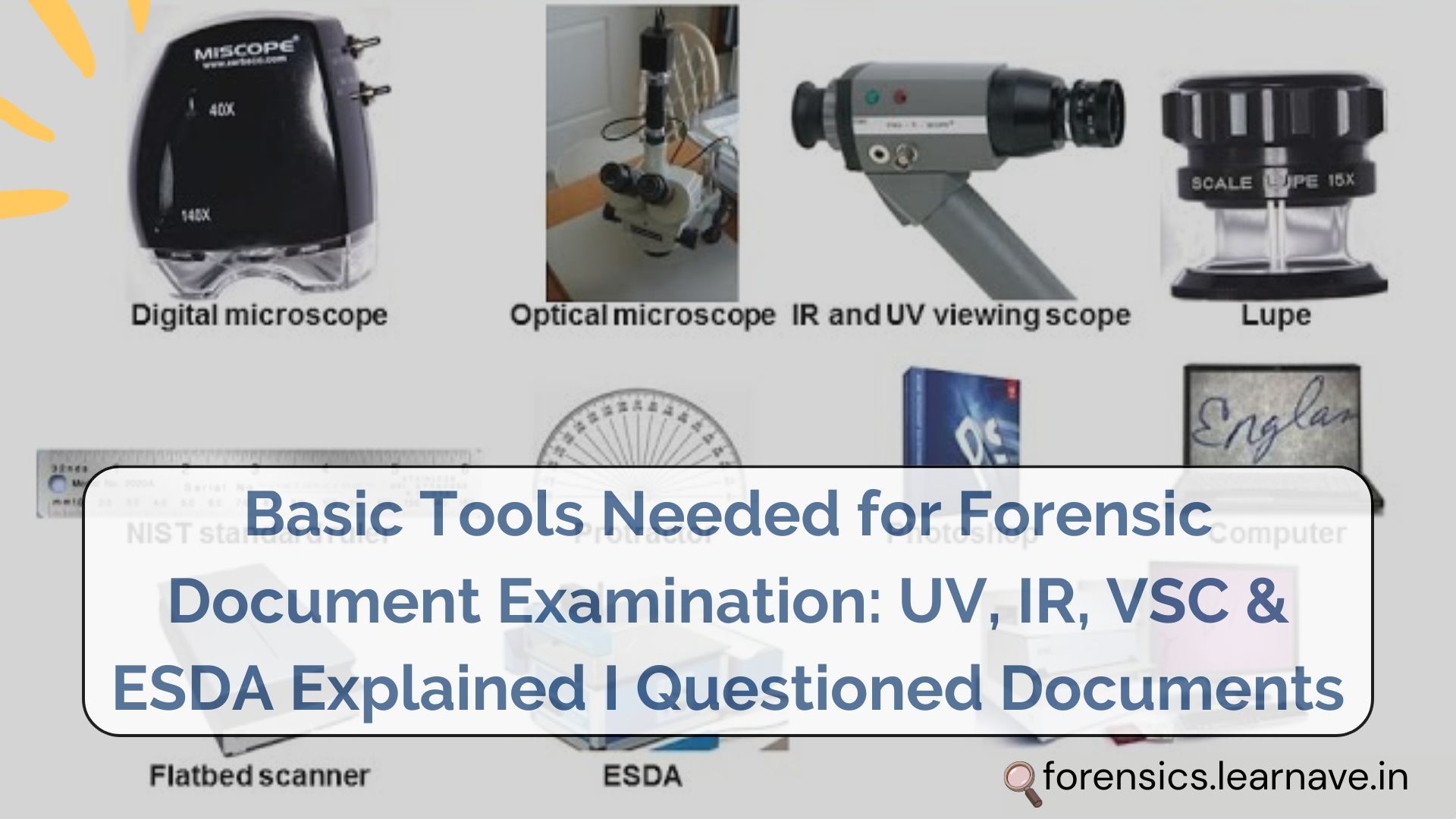
The most important purpose of questioned document examination is to make available evidence about a suspicious or questionable document by means of a variety of scientific processes and methods. Different types of tools and appliances are used for the purpose of questioned document examination such as magnifiers or microscopes, electrostatic detection apparatus, video spectral comparator.
Basic Measuring Tools
- Basic measuring tools comprises metric rulers, calipers for fine measurements and an assortment of glass alignment plates which allow comparison and measurement of angles, height, width and spacing of handwriting and typewriting.
- A tool for both measurement and magnification is a graticule/ reticle which is a magnifier eyepiece containing an imprinted measurement scale which allows the examiner to precisely measure what is viewed under the microscope.
- In alleged traced forgeries it often becomes necessary to investigate the question of identity in size, proportions and position of the various parts of an alleged model signature and of one or more traced imitations.
- Particularly as component of the initial investigation in such a case, or for final use for illustrating testimony, it is very important to make definite measurements of the various parts to be compared in order to show certain exact identities which may in combination be very strong evidence of forgery.
- For all such surface measurements finely graduated glass rules are best; with them more accurate measurements are made because the graduations are brought into real contact with the parts to be measured as cannot be done with the ordinary opaque rule.
- For somewhat longer measurements which are occasionally necessary there is a steel ruler which is graduated in fourths of an inch except that at one end a fourth inch space is graduated in hundredths of an inch.
- This design makes it possible to measure from any graduation up to six inches into the finely graduated space, as with the glass rule. By the use of needle pointed parallel dividers very precise measurements are made with this scale and for some purposes it is very helpful.
Magnification- Magnifiers / Microscopes
Document examiners use an extensive variety of magnification equipment.
- Handheld magnifiers enlarge the objects from 2 to 10 times (magnification powers of 2X to 10X) and also have lighting abilities as well to make brighter the field of view.
- To see facts more closely, there are several types of microscopes.
- A binocular, or stereo, microscope is easy to use because, like the name implies, there are 2 eyepieces and the viewer focuses with both eyes. In addition, a microscope has a third viewing tube that allows a still or video camera to be attached for “through the microscope” photography or videography. Digital microscopes combine optics for enlargement with digital capture technology to permit the user to view the magnified image on the monitor in its place or in addition to viewing it through the microscope eyepieces.
Light Sources
Light sources include transmitted light, infra-red light also long and short wave ultraviolet light. Transmitted light is simply light from the back of a document. This is most excellent provided by a light box which has a color corrected fluorescent type light bulb. The document can be laid upon the box and the light from the rear of the document makes it possible to see details not otherwise visible.
Ultra-Violet light
- The questioned documents can consist of identification of fake or genuine cards, contracts, statements, titles and deeds, certificates, stamps, bank checks, handwritten letters, machine-generated documents (such as photocopiers, fax machines and printers), currency and electronic documents.
- Out of all light sources, UV and IR are the significant sources of radiation that are widely used in the majority of the Questioned Document examination.
- Ultraviolet (UV) is a 10 nm to 400 nm wavelength electromagnetic radiation that is shorter than visible light but longer than X-rays. UV radiation is found in sunlight and contributes about 10% of the Sun’s overall electromagnetic radiation production. It is also generated by specialized arcs and lights such as mercury-vapor lamps, tanning lamps, and black lights.
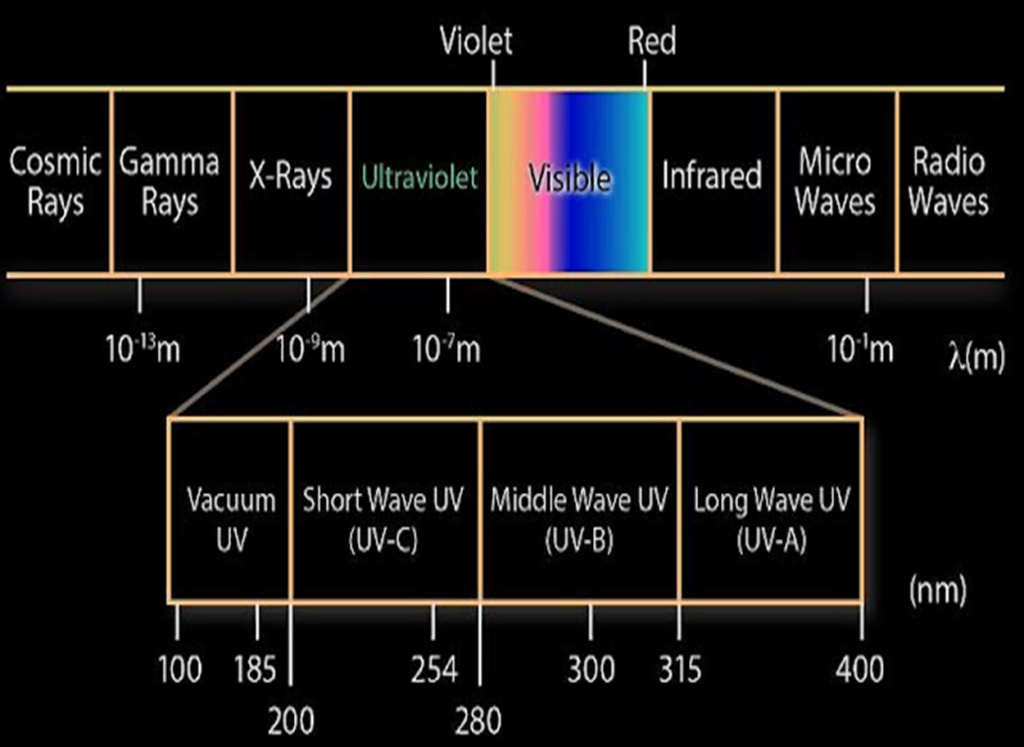
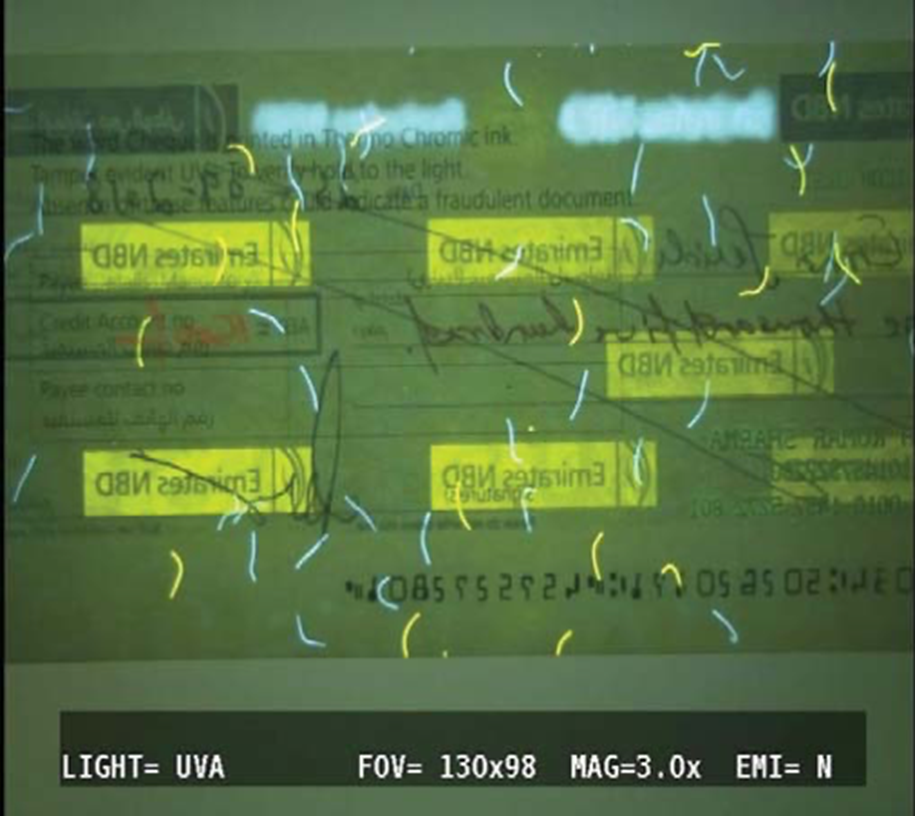
- Ultraviolet (UV) illumination techniques are used for multiple purposes in forensic investigations, including authenticating paintings, authenticating signatures, examining the documents in question, ink examination, highlighting latent fingerprints in crime scenes and tracing traces on clothes, detecting ink stains and identifying residual body fluid stains.
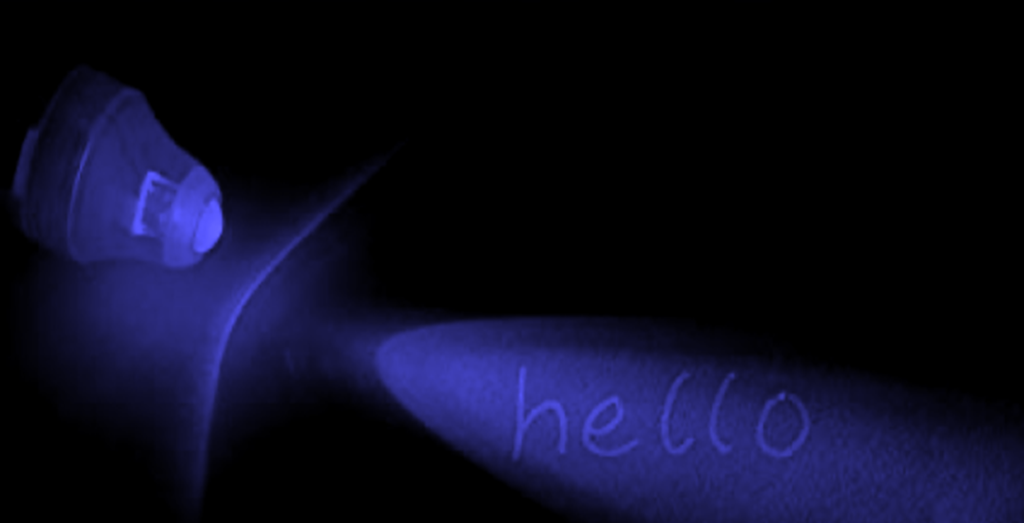
In QD examination, there’re several types of applications of UV rays. Some are listed below:
- Paper Examination: UV rays can be used to distinguish between various types of paper and paper textures. When subjected to UV, differently manufactured papers give distinguished fluorescence under UV rays. This is mainly because of the sizing (glazing) of the paper, for example, in some cases, it can appear greenish, and in others, it can be reddish. This is used to differentiate two different types of papers, even having the same experience.
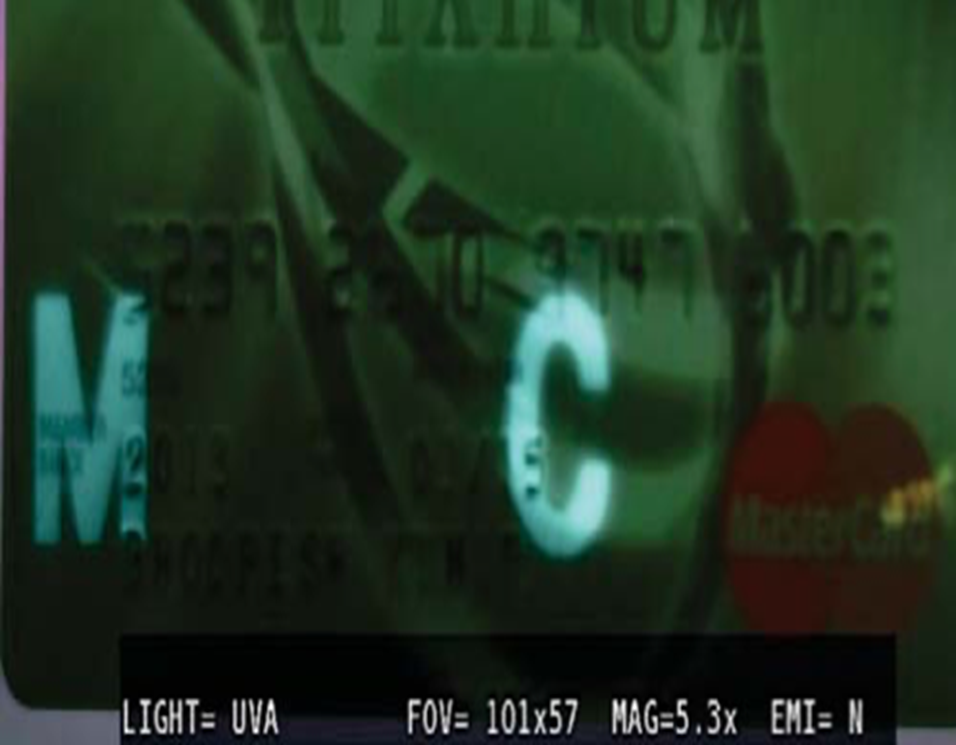
- Counterfeiting/ Counterfeited Currency or Others: Fake currency notes, security papers, passports, certificates, etc. will give different fluorescent due to the difference in sizing and the fibers present in the documents. Also, specific watermarks (Chemical and Mechanical) can be easily differentiated based on their luminescence under UV rays. Many of these government documents are embedded with multicolor security fibers that glow up in UV rays as red, green, and blue color. However, in fake documents, this will not be the case.
- Examination of Alterations in Documents: Usually the spots visible under UV light, may have been treated with any type of ink eradicator. Also, the eruption of the fibers during mechanically erasing of the matter can be evidently visible under UV radiations.
- Examination of Secret Writings: The secret writing can be made using biological fluids like urine, milk, saliva, semen, vegetable and plant juices, lemon juice, onion juice, quinine hydrochloride, and so on. Since all of these substances produce specific fluorescent under UV light, hence can be deciphered (visualized) and make the matter visible.
- Resealed Envelops : An envelope that has been opened and released with any type of glue may fluoresce differently under UV light.
- Paintings Examination: Fraudulently created paintings to showcase them as the genuine work of old times, can be detected by fluorescence test. Usually, varnishes used on an old painting will fluoresce differently from modern varnishes. Other alterations to an original painting can also be detected under UV radiations.There can be several other cases of tampered documents, ink analysis, stamp analysis that can be easily performed using UV radiations.
Visible light
- The visible light spectrum is the segment of the electromagnetic spectrum that the human eye can view. More simply, this range of wavelengths is called visible light. Typically, the human eye can detect wavelengths from 380 to 700 nanometers.
- All electromagnetic radiation is light, but we can only see a small portion of this radiation—the portion we call visible light.
- As the full spectrum of visible light travels through a prism, the wavelengths separate into the colors of the rainbow because each color is a different wavelength.
- Violet has the shortest wavelength, at around 380 nanometers, and red has the longest wavelength, at around 700 nanometers.
- VIS light has wavelengths between 400 nm and 700nm. Via the high resolution, VIS light is used to observe the changes on the document by taking macro and micro shots on the sample.
- The visible part of the spectrum is important as it helps distinguish between different colored inks, papers and security features.
Infrared and fluorescence spectroscopy
- Infrared radiation (IR), is electromagnetic radiation (EMR) with longer wavelengths than visible light. It is therefore generally invisible to the human eye, although it can be felt as heat by humans. IR wavelengths extend at 700 nanometers from the nominal red edge of the visible spectrum to 1 millimeter (300 GHz). Most of the thermal radiation emitted by objects near room temperature is infrared.
- One of the most characteristic feature of IR rays is that, they are readily absorbed and converted in to the heat energy.
- The basic source of IR radiation in forensic work is 1000 watt tungsten filament lamp.
- Various filters are needed to screen out all other light waves and to allow only IR rays to pass through.
Applications of Infrared in Questioned Document Examination:
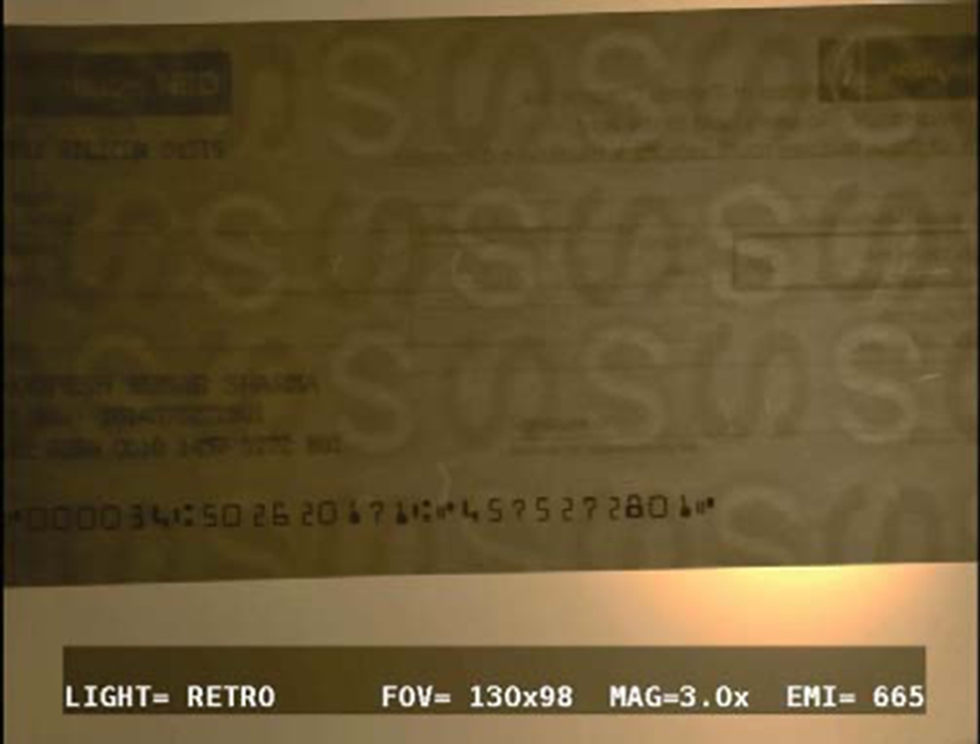
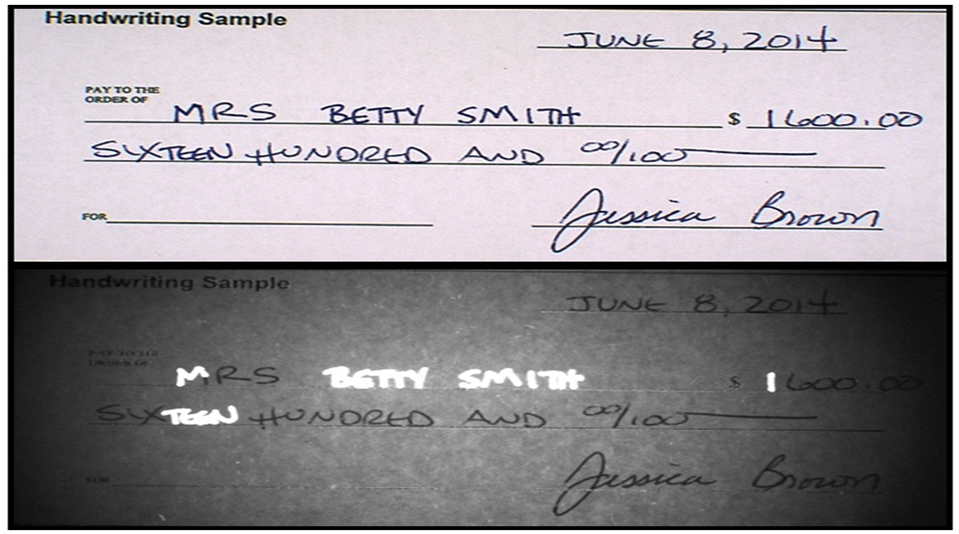
- Analysis of Inks: In any disputed or altered document, in which the use of two different types of inks is suspected, can easily be deciphered through infrared radiation.
- An example is given below in the image. This is due to the differences among the reflectivity of the ink used. One ink will be more reflective than the other under certain wavelengths of IR. Hence, one will be more darker and other will appear lighter.
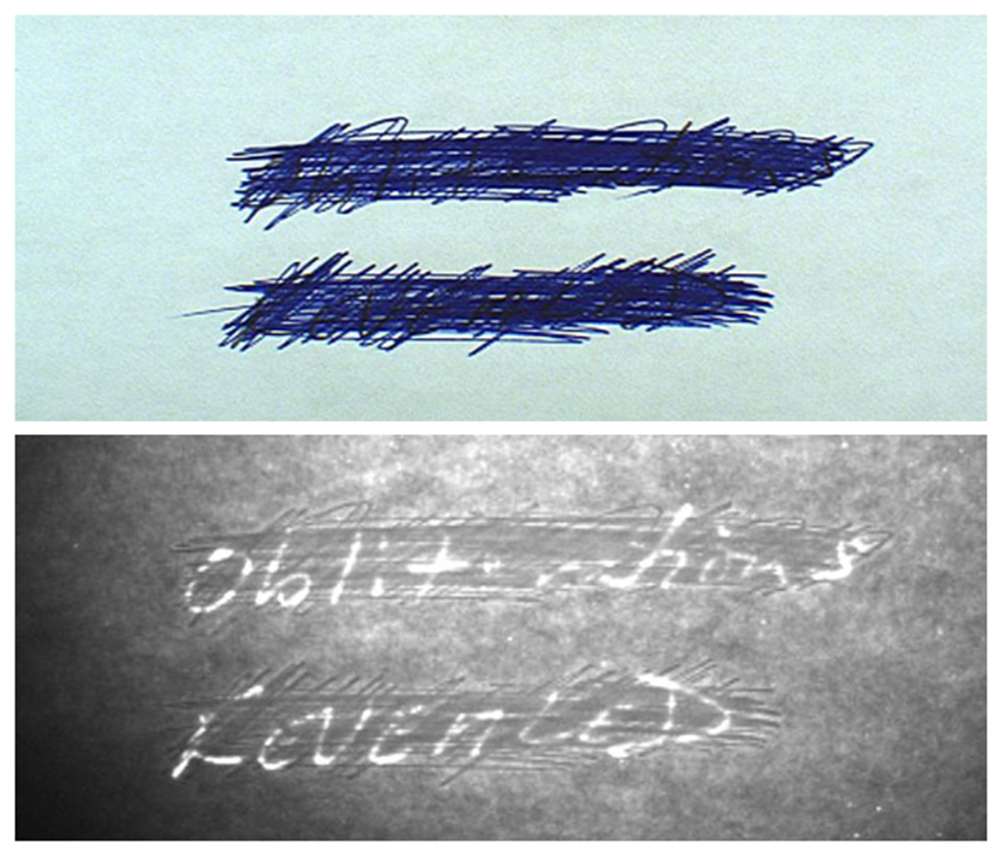
2. Analysis of Obliterated Writings: Writings can be obliterated in number of ways. For instance, by using correction fluid and then over-writing, or by damaging the previous text and then over-writing or in any other such manner.
- One ink will be opaque and other will be transparent at certain wavelength. Therefore, by changing the wavelengths of IR radiation, it is possible to read the obliterated matter easily.
3. Examination of Erasures: Small particles of the ink or pencil often linger in the outline when writing is erased mechanically. With an infrared radiation or infrared imaging, it may be possible to make the writing clear.
4. Charred Document Examination: The burnt document examination, sometimes is only possible through infrared photography, however, it depends upon the type of the ink used and the degree of burning.
5. Cancellation Marks: After their first cancellation, postal stamps are often reused. The cancelation mark residues may not be visible duets the stamp’s dark background. An infrared photograph may reveal the remains of previous marks of cancellation.
6. Water Damaged Documents: By photographing the water damaged documents with the aid of light transmitted by the blue-green infrared blocking filter, the residual ink in the paper fluoresced in the infrared and this can be recorded further to decipher the written matter.
Photomicrography
- Photomicrography is the practice of photographing microscopic objects or creatures, usually for scientific purposes.
- Photomicrography is widely used in forensic labs and medical research, as well as other fields that require study of microscopic details. In the 19th and 20th centuries, photomicrographs, also called micrographs, were produced by connecting or aligning a film camera with a microscope, a complicated process.
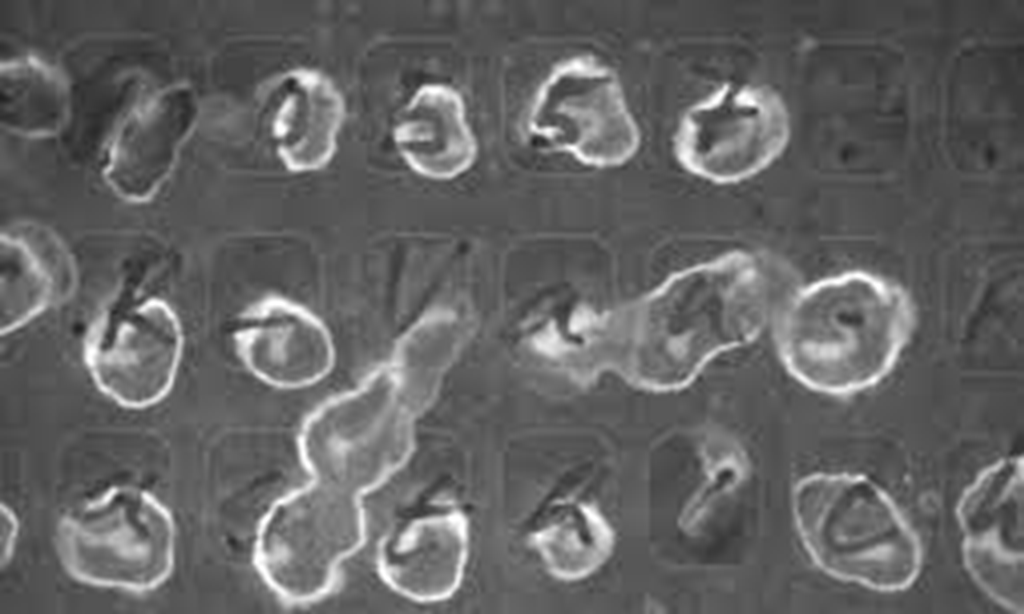
- Photomicrography was pioneered in the 1800s, only a few decades after the introduction of photography itself. Scientists quickly realized that photomicrography would facilitate the study of cell structure, disease bacteria, and other microscopic matter.
- When forensic science came into use in crime investigation in the early 20th century, photomicrography became an important tool for examining trace evidence, tiny details that can connect a suspect to a crime scene.
- Camera zoom lenses and microscopes work on the same basic principle: using magnifying lenses, and sometimes mirrors, to enlarge a point while retaining clear focus.
- Early photomicrography involved complex arrangements of cameras and microscopes.
- In some cases, the camera’s lens was actually removed, making the microscope effectively serve as its lens.
- Digital technology has eliminated the need for such painstaking device alignments; the microscopic image is processed as digital data.
- This data can be saved on a computer, stored as a still image or video, and enlarged on a screen, all while the object is still under the microscope.
- Photomicrography may be best known in modern times for its use in processing trace evidence from crime scenes.
Microphotography
- Microphotography involves taking photographs on very small film to produce small images that can only be viewed when magnified.
- Whereas photomicrography simply involves taking pictures (photographs) using a microscope, Microphotography is the process through which the size of a photograph is reduced so that it can only be viewed using a microscope.
- Because of the technique allows for a significant reduction in size of photographs, it has proved to be particularly beneficial for many libraries that are today using it for documentation.
- In microphotography, the photographer uses a special negative known as a microfilm to preserve the images. Here, the subject to be photographed (documents etc) may be photographed in one of two ways; a linear array or a two dimensional array.
- The ordinary microfilm roll is a good example of linear array micrograph. The standard film measure 16mm, 35, 70mm or 105mm in width and may be perforated on one or either edges.
- Typically, the photographer photographs consecutive pages of the document by capturing a single or a pair of pages.
- Given that microfilm rolls tend to be of greater lengths, microfilm strips which are composed of six frames can also be used.
- For reading purposes, microfilm strips have been shown to be more suitable compared to microfilm rolls.
- This is largely due to the fact that it’s easier to find a specific page in a strip that contains six frames.
- Two dimensional array micrographs tend to carry more pages compared to the microfilm and the microfilm strip.
- This makes the two dimensional array more convenient for library applications given that their size allows for many more documents to be photographed and saved.
Video Spectral Comparator (VSC)
It is designed to meet the requirements of immigration authorities, government agencies and forensic science laboratories. The VSC includes advanced features for the examination, comparison and authentication of documents including passports and travel documents, official letters and breeder documents, banknotes and cheques, works of art and valuable artifacts through the detection of irregularities.
Electrostatic Detection Device (ESDA)
ESDA is an electrostatic detection device that is a specialized apparatus regularly used for questioned document analysis to decipher indentations or impressions in paper. It is a non-destructive technique. It is a sensitive technique capable of detecting indentations or impressions or sub-surface writings created on pages which are several layers beneath the top-most sheet. It is also sensitive to the writings that were created many years back because of which indentations were made. It is a device used to visualize indented writing, which is a type of evidence which may be encountered during questioned document analysis in the cases of ransom note and extortion letters.
Join Our WhatsApp Channel –
REFERENCE :
- Osborn, A.S. (1929). Questioned Documents, 2nd ed. Albany, New York: Boyd Printing Company. Reprinted, Chicago: Nelson-Hall Co.
- Harrison, W.R. (1958). Suspect Documents: Their Scientific Examination. New York: Praeger.
- Conway, J.V.P. (1959). Evidential Documents. Illinois: Charles C Thomas.
- Hilton, O. (1982). Scientific Examination of Questioned Documents. New York: Elsevier Science Publishing Co.
- Huber R.A. & Headrick A.M. (1999). Handwriting Identification: Facts and Fundamentals. Boca Raton: CRC Press.
- Ellen, D. (2005). Scientific Examination of Documents: Methods and Techniques, Third Edition. Boca Raton: CRC Press.
- Morris, R. (2000). Forensic Handwriting Identification: Fundamental Concepts and Principles. Academic Press.
- Levinson, J. (2001). Questioned Documents: A Lawyer’s Handbook. San Diego: Academic Press.
- Köller, Norbert; Nissen, Kai; Rieß, Michael; Sadorf, Erwin (2004). Probabilistische Schlussfolgerungen in Schriftgutachten (Probability Conclusions in Expert Opinions on Handwriting) (PDF) (in German and English). Luchterhand, Munchen: BKA. Retrieved 25 August 2023.