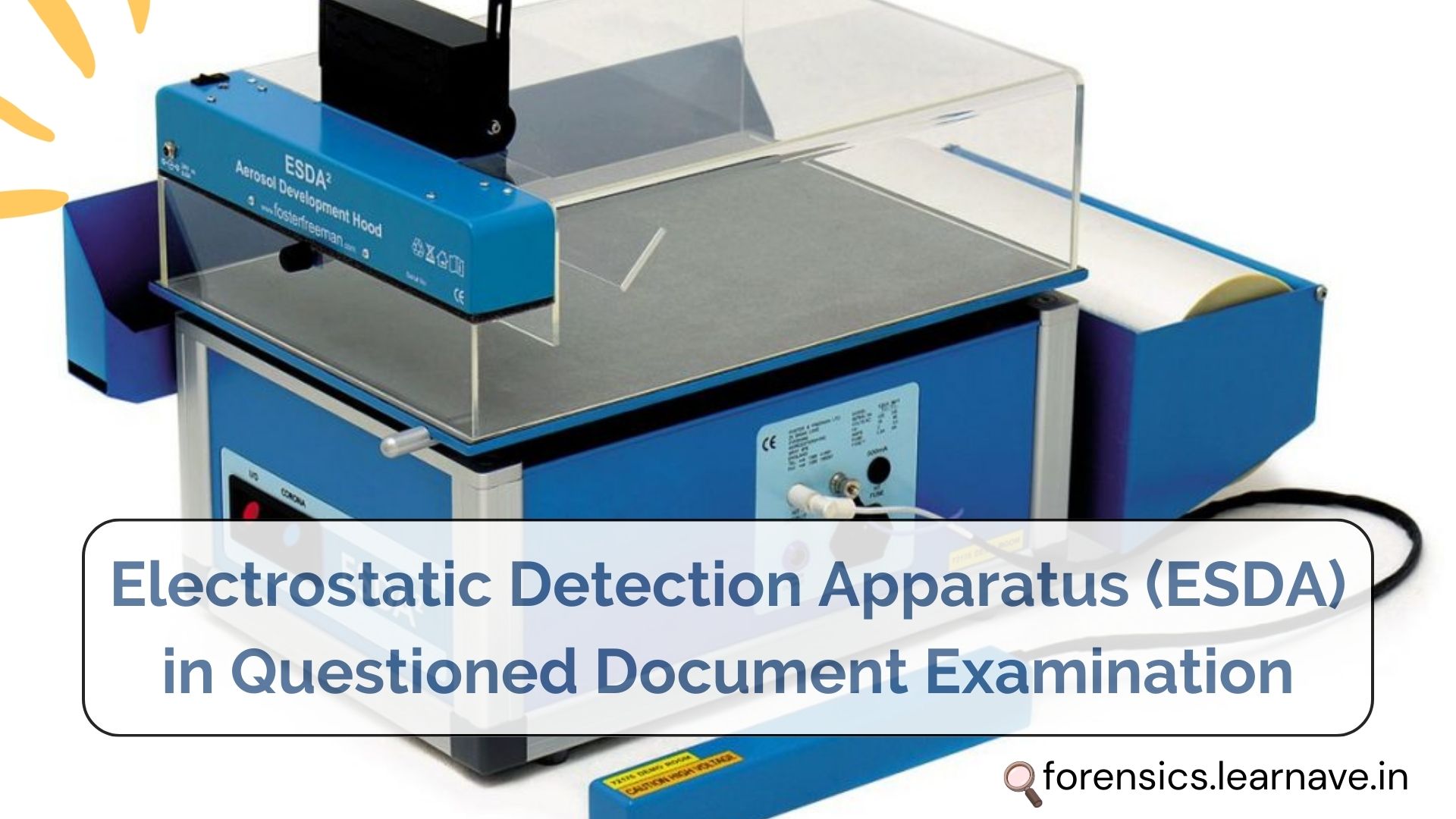
What is Electrostatic Detection Apparatus (ESDA)
- An instrument used for questioned document examination to reveal the indentations or impressions which may be present on paper.
- Manufactured by Foster and Freeman.
- Capable of detecting indentations or impressions or sub-surface writings created on pages which are several layers beneath the top-most sheet.
- ESDA takes advantage of the technology used in copying machines and laser printers to help visualize the indented writing.
Principle of Electrostatic Detection Apparatus
- The ESDA uses the principle that indented areas of the document carry less negative charge than surrounding areas.
- This causes the toner (negatively charged particles) used in the Electrostatic Detection Device (EDD) to be attracted to these areas, revealing indentations.
- The EDD is able to visualize indentations because the surface is differently charged depending upon whether or not an indentation is present.

Working of Electrostatic Detection Apparatus (Step-by-Step)
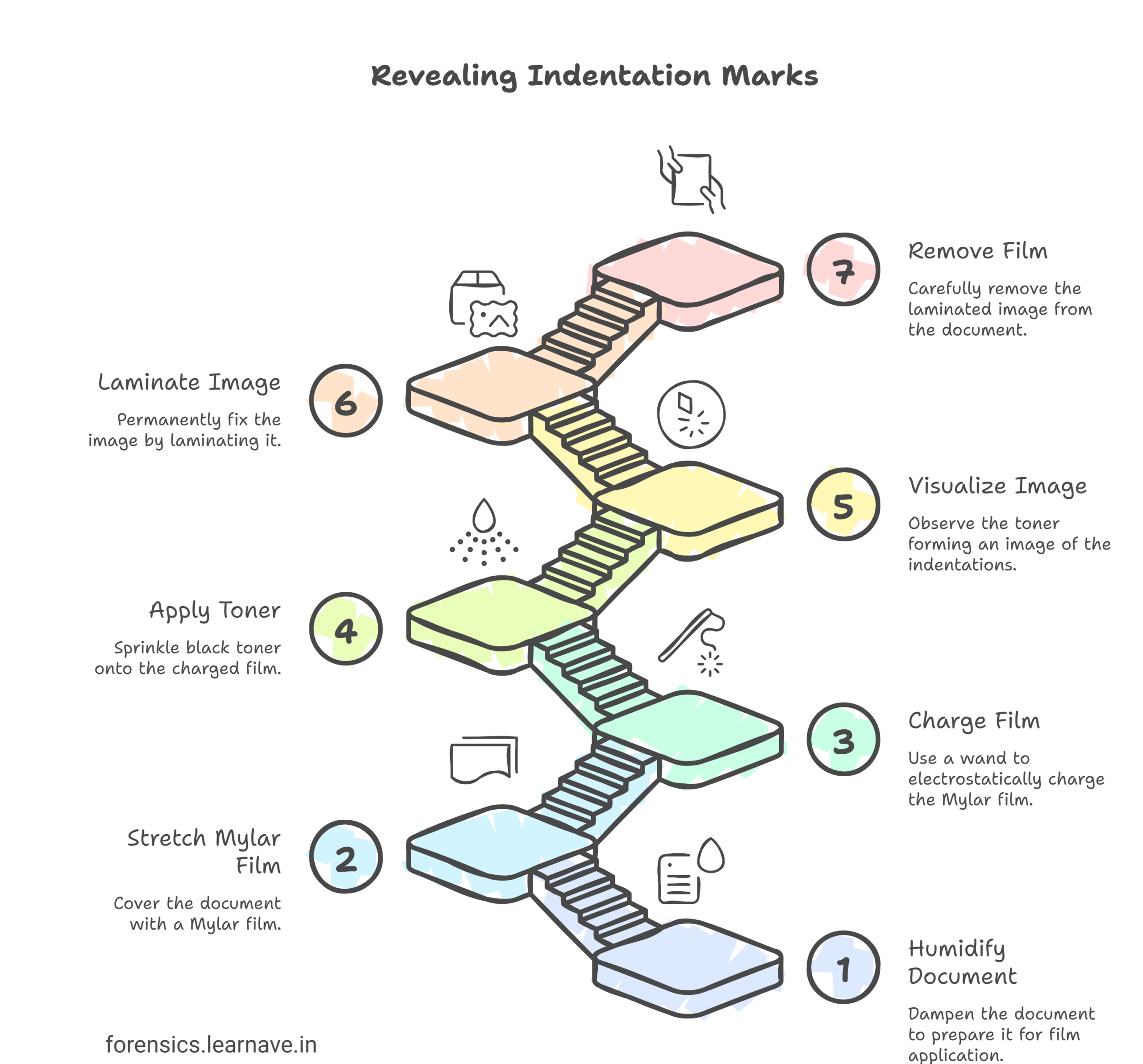
- To reveal indentation marks from document, is to step is to humidify it.
- Then stretch a Mylar film (like Clingfilm) over the document.
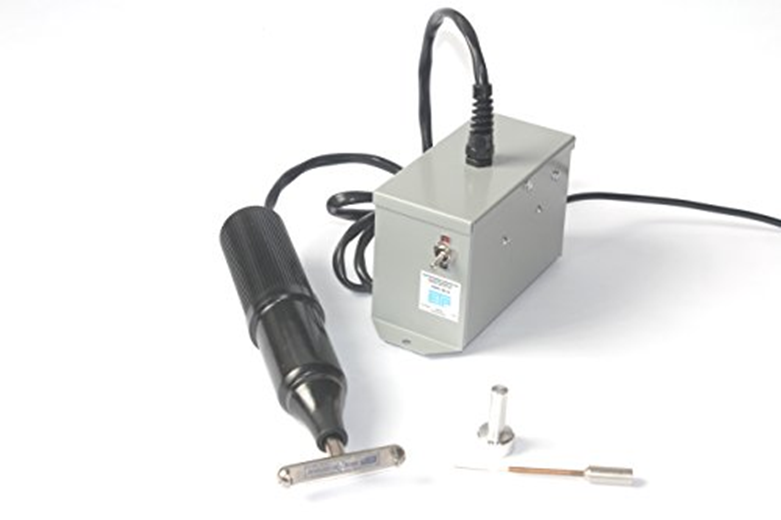
- This Mylar film is then electrostatically charged using a “wand” (a long thin stick or rod) containing a fine wire charged to 7 kV.
- Where the paper is smooth, the charging is generally uniform.
- However where the fibres of paper have been disturbed by paper-paper contact caused by indentations, the electrostatic charge is different to the background.
- This creates a latent image, to visualise the indentations, black toner is applied to the surface of the Mylar.
- The toner sticks where the electrostatic charge congregates (in the areas of indentations).
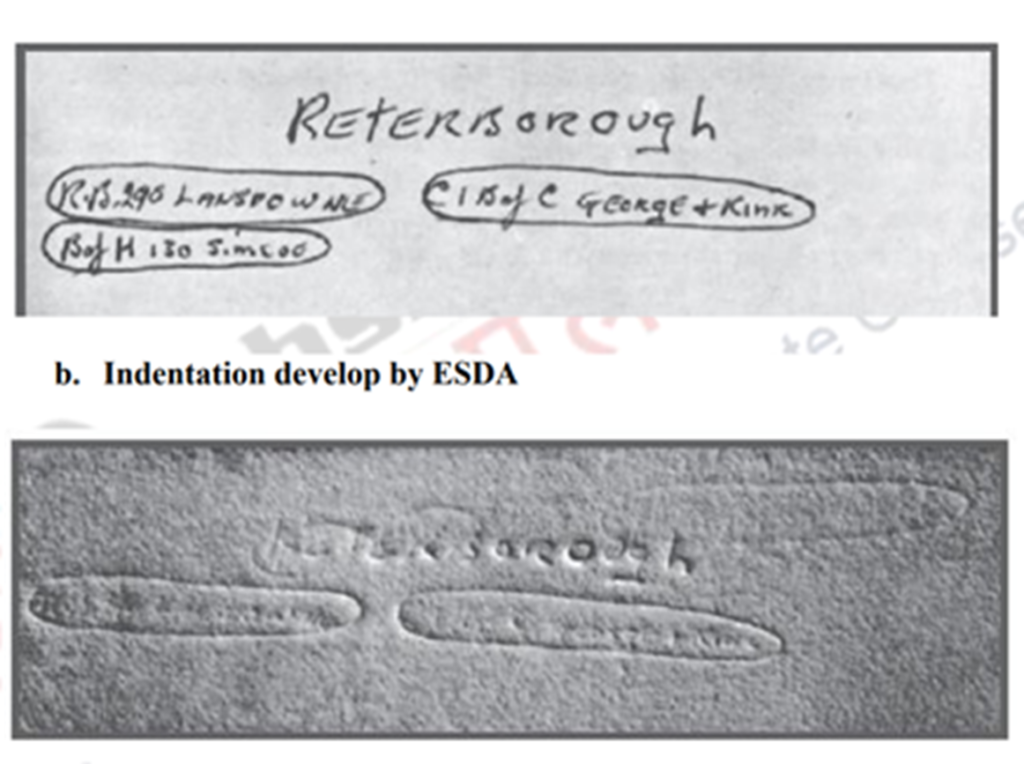
- This results is an image with a grey toner background and the darker toner traces in the areas where there are indented impressions.
- ESDA image is made permanent by laminating the imaging film with a sheet of adhesive fixing film, SLR Photography or Scanning Process.
- The laminated ESDA image is removed for the further examination, leaving the original document unaffected.
Adhesive Lift Method in ESDA
- The sheet or fixing paper is used to record the deciphered indentation.
- Fixing film is relatively a rigid sheet which is self-adhesive.
- The transparent polymer film is removed from backing material and cautiously fixing film is kept over the charged film.
- Pressure is applied carefully to fix the film by smaller roller then create sandwich so as to easily lift.
- After the lifting, the examiner observes developed indentation before making visible markings on the develop indentation paper.
Advantages of Electrostatic Detection Apparatus
- Non-destructive technique.
- Indented impressions have been recovered from upto seven layers of paper beneath the original writings.
- The impressions can be successfully visualised from documents upto sixty years old.
- It can also be used to lift footprints in dust.
Disadvantages of Electrostatic Detection Apparatus
- Not suitable for the examination of loose paper such as newspaper or very glossy such as magazine covers.
- If a document gets wet by any liquid, it will completely destroy the ESDA impressions.
Factors Influencing ESDA Image Quality
- Document Humidification
- Paper Type: Paper has a very variable composition and differences in the basic raw materials, chemical treatment, impregnation or surface finish will generally affect both the contrast and degree of background development in the image.
- The amount of charge is affected by material type, speed of contact and separation, humidity and several other factors.
Important Notes for ESDA Examination
- If ambient relative humidity is less than 60% than document humidification is required & if the ambient relative humidity is greater than 60% than document humidification is not required.
- Extreme humidification can destroy the document.
- Deep or heavy indented writing on a page should not be taken for examination because ESDA fails to decipher deep indentations, so that time we can take 3rd or 4th sheet of document for examination as it will have normal indentations and can be deciphered by ESDA.
- Heavyweight, coated or treated papers give poor results.
Forensic Significance of Electrostatic Detection Apparatus
- For visualising traced forgery.
- A questioned document such as ransom note, cheques etc. may exist which can be determined to be the source of indentation detected on another piece of paper.
- Decipherable indentations may also provide valuable information even when a second document is not present or cannot be located.
- Documents that do not contain visible identifiable marks may contain valuable impression evidence if they were underneath other documents when the writing was performed.
Conclusion
Electrostatic Detection Apparatus (ESDA) is an important non-destructive tool used in questioned document examination for the detection and visualization of indented impressions. It is especially useful in cases where no visible writing is present on a document, but impression evidence may exist due to writing performed on sheets placed above it.
By using the principles of electrostatics, ESDA enables examiners to recover valuable information from multiple layers of paper, even from old documents, without causing damage to the original evidence. Despite certain limitations related to paper type, moisture, and deep indentations, ESDA plays a significant role in forensic investigations involving traced forgery, ransom notes, cheques, and other questioned documents.
Overall, Electrostatic Detection Apparatus holds great forensic significance as it helps uncover hidden impression evidence that can assist in establishing links between documents and contribute to the reconstruction of events during document examination.
Reference:
- https://en.wikipedia.org/wiki/Electrostatic_detection_device
- Foster + Freeman Ltd. ESDA2 information
- CSI Forensic Supply (formerly Kinderprint) site
- Projectina CH Docustat 220 information Archived 2018-09-12 at the Wayback Machine
- A more detailed description of the process
- A detailed presentation followed with experiments, of how the ESDA device is useful in Forensic Handwriting Examination (in Greek).